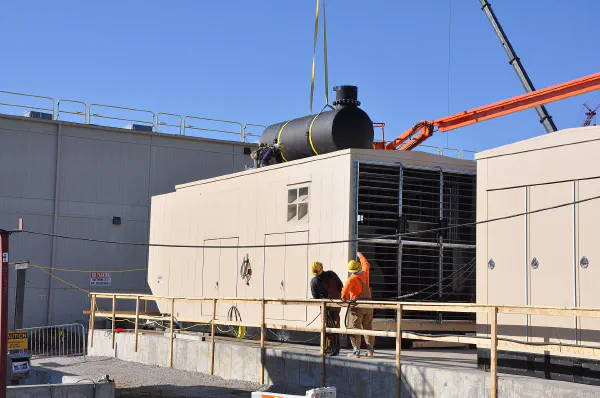
An offer for “eight hours of fuel” needs a second line: eight hours at which load, using which consumption data and available fuel volume? Send every supplier the same operating profile and ask for the calculation behind its proposed tank. A nominal tank capacity alone is not a runtime commitment.
Keep the question separate from generator sizing. This guide helps you define the fuel requirement; it does not determine the engine rating or design the fuel installation.
State the operating profile
Describe the required duration and the electrical demand expected during that period. If demand changes, divide the period into meaningful intervals rather than supplying only the largest connected load. Identify whether refuelling is permitted during the required period and who will confirm the operating plan.
Ask the supplier for consumption data for the actual generator configuration at the relevant loads. Do not assume that consumption at half load is exactly half the full-load figure. When different offers use different fuel assumptions, ask for a common comparison basis.
Caterpillar’s fuel-consumption paper explains that fuel properties and quoted tolerances affect comparisons. Ask bidders to disclose their basis instead of comparing two litres-per-hour figures without their notes.
Ask what volume is actually available
Request the tank’s stated capacity, permitted filling volume, usable volume and the fuel available for the required duty after any agreed reserve or operating limits. Have the supplier define each term and explain any difference. Keep reserve allowances visible so they are not silently omitted or counted twice.
The Cat XQ2280 specification distinguishes fillable and usable fuel capacity and labels runtime by load. That model is an example of the information to request, not a tank recommendation for another installation.
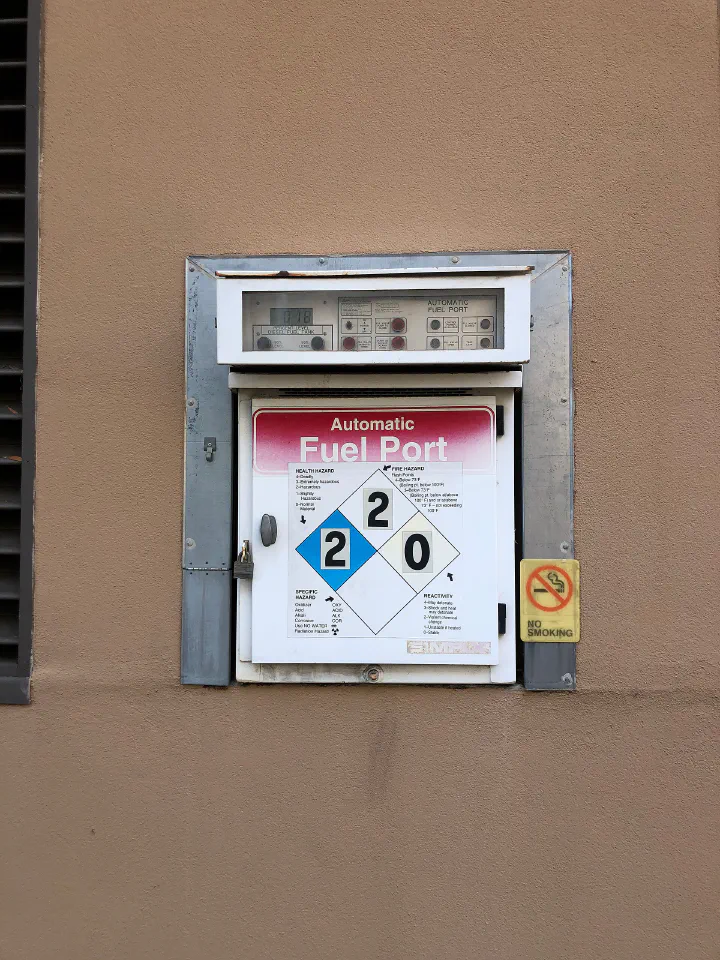
A Simplex diesel-fuel filling port at the Juniper Hotel in Cupertino, California. The photograph shows a filling interface, not the tank volume or available runtime.
Photo: Minh Nguyen · CC BY-SA 4.0Check the arithmetic before the tank size
For a constant stated fuel rate, fuel required equals operating hours multiplied by consumption in litres per hour. For a changing profile, calculate each interval and add the volumes.
Illustrative arithmetic only: suppose the supplied rates were 20 L/h for the first 2 hours and 30 L/h for the following 6 hours. The calculated consumption would be:
(2 × 20) + (6 × 30) = 220 L over 8 hours.
These are invented teaching inputs, not measured consumption, equipment ratings or a recommended tank size. The result excludes any additional agreed reserve and installation-specific restrictions. Replace the inputs with the selected model’s documented figures before using the calculation in procurement.
Make each offer answer the same questions
| Ask for | What must be clear |
|---|---|
| Duration and load | The demand in each interval and whether refuelling is allowed |
| Consumption evidence | Generator configuration, data source, units and stated assumptions |
| Tank volume | Capacity terminology and the usable fuel available for this requirement |
| Reserve | Its purpose, amount and treatment in the calculation |
| Supply boundary | Included tanks, transfer equipment, controls and installation work |
Ask the bidder to identify which parts of the fuel arrangement remain subject to site design. A supplier’s runtime calculation does not settle tank placement, pipework, filling access or local approvals.
Record the refuelling responsibility
If the plan depends on deliveries, record who arranges them, how the delivery point is accessed and what assumption the quotation makes about availability. If the requirement is to run without refuelling, state that explicitly. Attach the relevant layout from the site-information pack.
Before comparing prices, have every supplier return the same load profile with its calculation, volume definitions and exclusions. This makes a runtime promise something you can review rather than an unexplained number beside the tank description.
Sources & scope
- Comparing Volumetric Fuel Consumptions | Cat | Caterpillar Explains why fuel properties and stated tolerances matter when comparing consumption data; no universal correction factor is applied here.
- Cat XQ2280 Rental Generator Set — LEHX21160-05 The retrieved model sheet separates fillable and usable fuel volumes and identifies a load basis for runtime. Its figures are not used as project inputs.
General procurement guidance. Worked examples are illustrative; final selection requires the selected manufacturer's documentation and a project-specific engineering review.