Send the supplier a marked site plan, the operating conditions to assess, delivery and service access details, and the boundaries of the installation package. Add photographs that explain obstructions and interfaces. Give every bidder the same revision, with unresolved items clearly assigned for follow-up. A postcode and a requested kVA rating leave too much room for different assumptions.
This guide concerns the site brief. Keep the electrical specification and backup-load schedule alongside it rather than trying to replace them with a location description.
Establish the site baseline
Identify the facility, country and proposed generator position. Say whether the proposal is for an indoor room, outdoor enclosure, roof or another location still under review. Mark the exact position on a drawing; a photograph of the building frontage is not enough.
Record the environmental conditions the supplier must assess. Caterpillar’s sizing workflow includes maximum ambient temperature, altitude and humidity. Supply project values with their source, or identify who will confirm them. Leave any resulting rating adjustment to the selected equipment’s assessment.
Show delivery and service access
Use an annotated layout to distinguish the space available for the equipment from the route used to bring it in. Mark doors, gates, overhead restrictions, adjoining equipment and areas that cannot be occupied. Ask the delivery contractor to confirm handling arrangements against the proposed shipping dimensions and weight.
Then ask a different question: how will someone reach the controls, service points and components after installation? Rehlko’s installation article distinguishes ease of delivery from long-term serviceability. Its discussion of enclosure doors and cable entry is a useful reminder to review the surrounding layout, not only the footprint.
Request the manufacturer’s general arrangement and required access spaces. Put these on the project drawing for review rather than inserting a generic clearance into the enquiry.
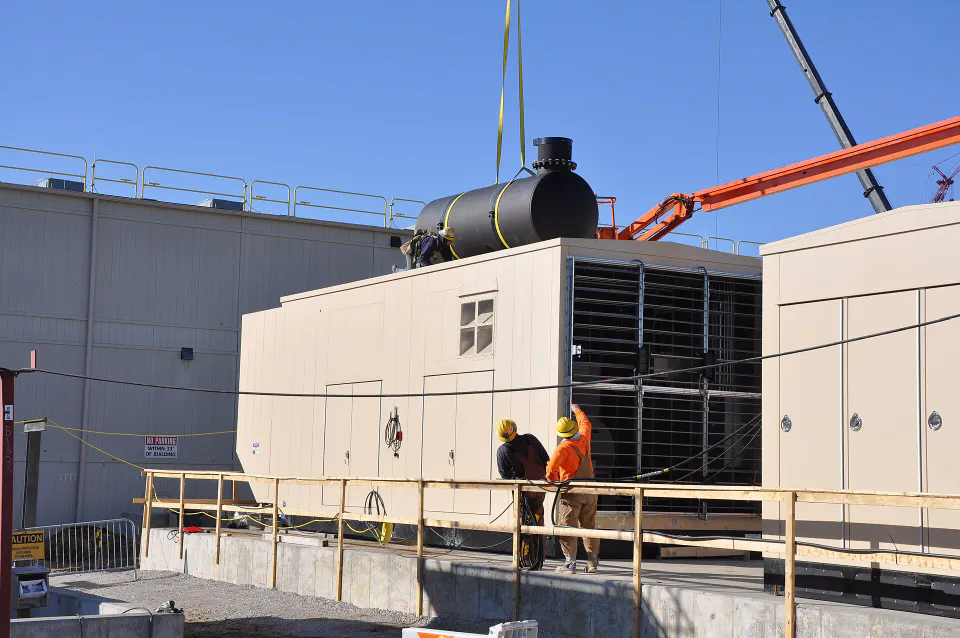
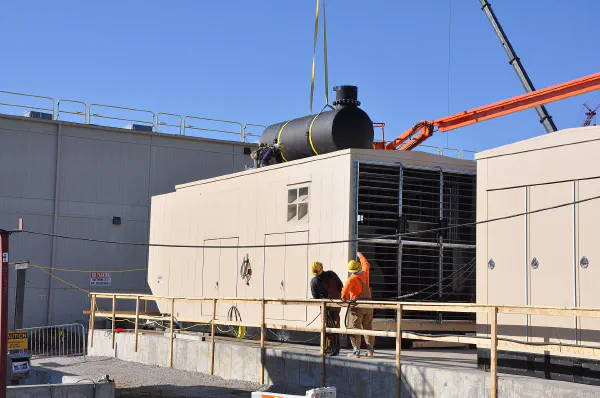
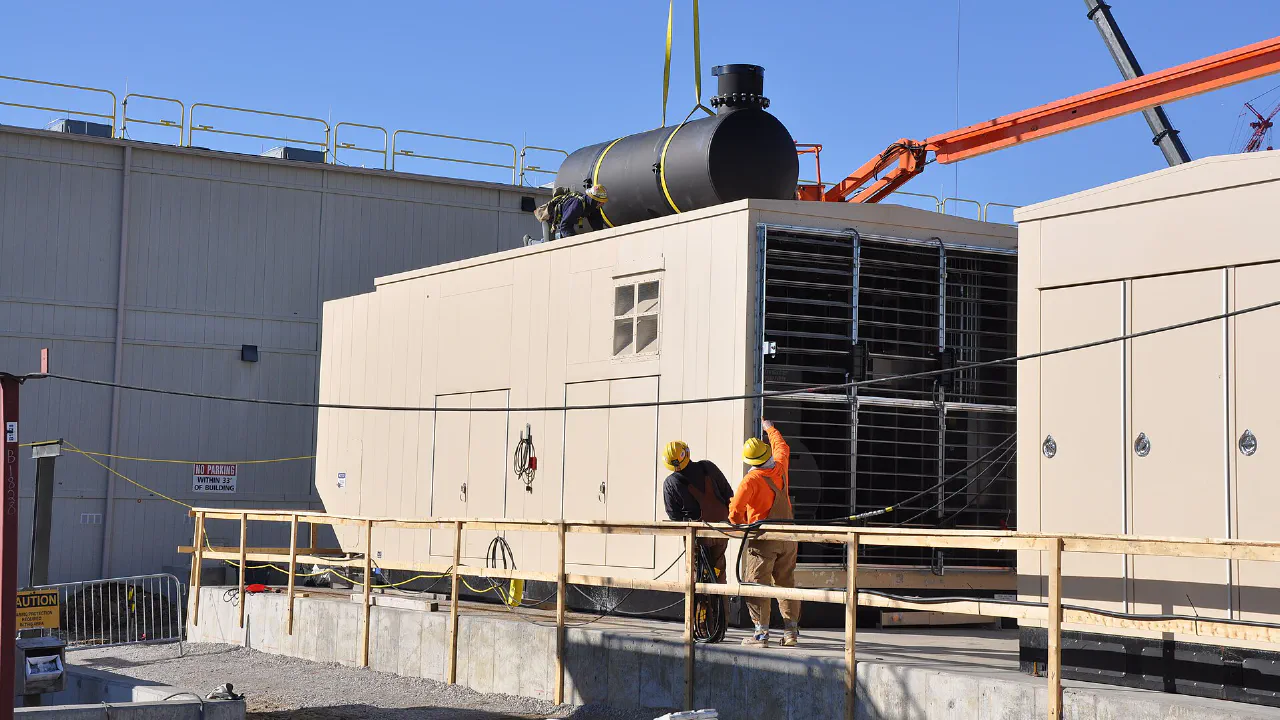
Installation of an exhaust muffler on a standby diesel generator at the Blue Grass pilot plant. Enclosure, exhaust and site access all need space.
Photo: PEO ACWA · CC BY 2.0Describe air, exhaust and noise constraints
Mark nearby walls, overhead structures, building openings and other heat-producing equipment. Show the proposed cooling-air and engine-exhaust discharge areas separately. Ask the supplier and installation designer to identify which routes need calculation or further site information.
Cummins’ outdoor-enclosure paper explains that the surroundings can restrict cooling airflow. A weather enclosure does not, by itself, resolve the installation layout.
For noise, name the receiving location that matters to the project: for example, a neighbouring property boundary or occupied workspace. Attach any confirmed project criterion, including its measurement conditions. If the criterion is unknown, assign its confirmation to the project team before treating a supplier’s sound figure as acceptance evidence.
Define fuel and electrical interfaces
State the required operating duration and the load profile it relates to. Describe the proposed fuel-storage location and refuelling access, then ask which tanks, pipework, controls and installation work each quotation includes. Keep an unconfirmed tank arrangement visible as an open item.
For electrical interfaces, mark the intended transfer equipment and distribution connection locations. Identify who will provide cable-route information, termination details and auxiliary supplies. Ask the supplier to list the information it still needs; these enquiry notes are not connection instructions.
Caterpillar’s rental planning guidance treats fuel access, cable routes and on-site support as practical planning questions. Confirm the arrangements for this project rather than borrowing a rental setup unchanged.
Assemble a usable enquiry pack
The following is an editorial checklist for assembling documents, not a completed site assessment.
| Include | Make it useful | Confirm with |
|---|---|---|
| Site plan | Mark the proposed position and drawing revision | Facility owner or designer |
| Environmental brief | State design inputs and their evidence | Project engineer |
| Delivery sketch | Identify restrictions and the proposed handling route | Delivery contractor |
| Service layout | Show doors, access spaces and adjacent equipment | Supplier and maintenance team |
| Air and exhaust sketch | Identify proposed routes and nearby openings | Installation designer |
| Fuel and electrical scope | Record package boundaries and unresolved interfaces | Relevant contractors and supplier |
| Photograph index | Label each view and link it to the plan | Site contact |
Send an indexed pack rather than an unexplained collection of images. A useful photograph has a location, viewing direction and a short note explaining what the bidder should notice.
Close questions before comparing offers
Give each unresolved item an owner, a required response and a decision point. For example: “Exhaust route not confirmed; installation designer to issue the route; supplier to state what remains excluded until that review.” This is an example of issue wording, not a report about an actual project.
Ask bidders to return their assumptions and exclusions against the same pack revision. When the location or route changes, circulate the updated pack to everyone and ask which parts of the offer need revising. Use the RFQ checklist to bring those responses into the quotation comparison.
Sources & scope
- Commercial Generator Sizing Calculators | Cat | Caterpillar The manufacturer's sizing workflow asks for maximum ambient temperature, altitude and humidity, alongside electrical and load information. It does not establish the conditions at a buyer's site.
- Protecting your power: Specifying outdoor generator enclosures Cummins Power Topic 7014, copyright 2007. Background on outdoor enclosure airflow, surroundings and refuelling access; not used as a statement of current local code or universal clearance requirements.
- 3 Things To Think About When Installing Your New Generator Rehlko's June 2025 data-centre article distinguishes installation convenience from service access and discusses planning enclosure cable entry with the site layout. Those points do not validate a particular installation.
- Rental Power Planner | Cat | Caterpillar Temporary-power planning questions cover fuel storage, cable routes and on-site support. Used for enquiry questions, not to apply rental-specific runtime recommendations to permanent installations.
General procurement guidance. Worked examples are illustrative; final selection requires the selected manufacturer's documentation and a project-specific engineering review.