Include the generator’s electrical and installation context, the proposed output breaker’s ratings and functions, and the protection data needed to compare its operation with the alternator’s limits and downstream devices. Ask the supplier to identify assumptions and submit the relevant curves; the project’s responsible electrical team should assess coordination and resolve open design questions.
Identify the system and installation
Give the supplier enough context to assess the breaker as part of the installation, rather than as an isolated component. State the generator’s intended duty and operating arrangement, including whether it will operate alone or in parallel, and identify the connected system and downstream protection devices that are relevant to the assessment.
Include or request confirmation of:
- Generator output voltage, frequency, phase, and rated output.
- Earthing or grounding arrangement and which conductors are switched or protected, as defined by the project design.
- Whether the breaker is generator-mounted, separately installed, or part of another assembly.
- The connected conductor information needed for the design review, including the intended conductor ampacity where known.
- Downstream breaker or protective-device details, and the available coordination or selectivity criteria.
- The applicable project and destination requirements, identified by the project team rather than assumed by the supplier.
If details are not yet fixed, label them as provisional or unknown. Do not let an unconfirmed site condition become an unstated supplier assumption.
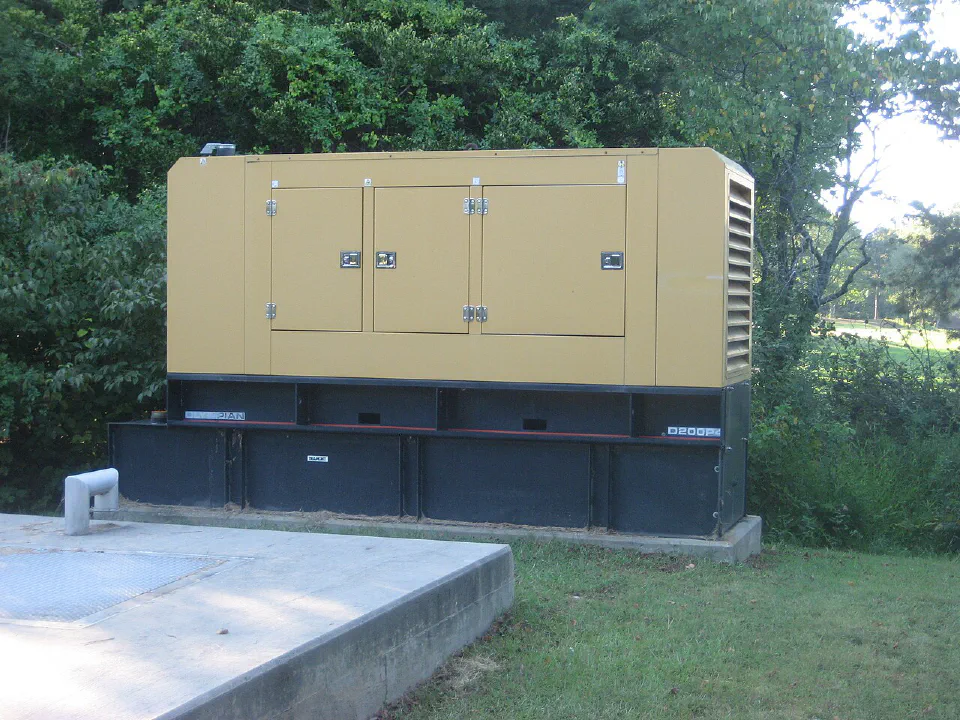
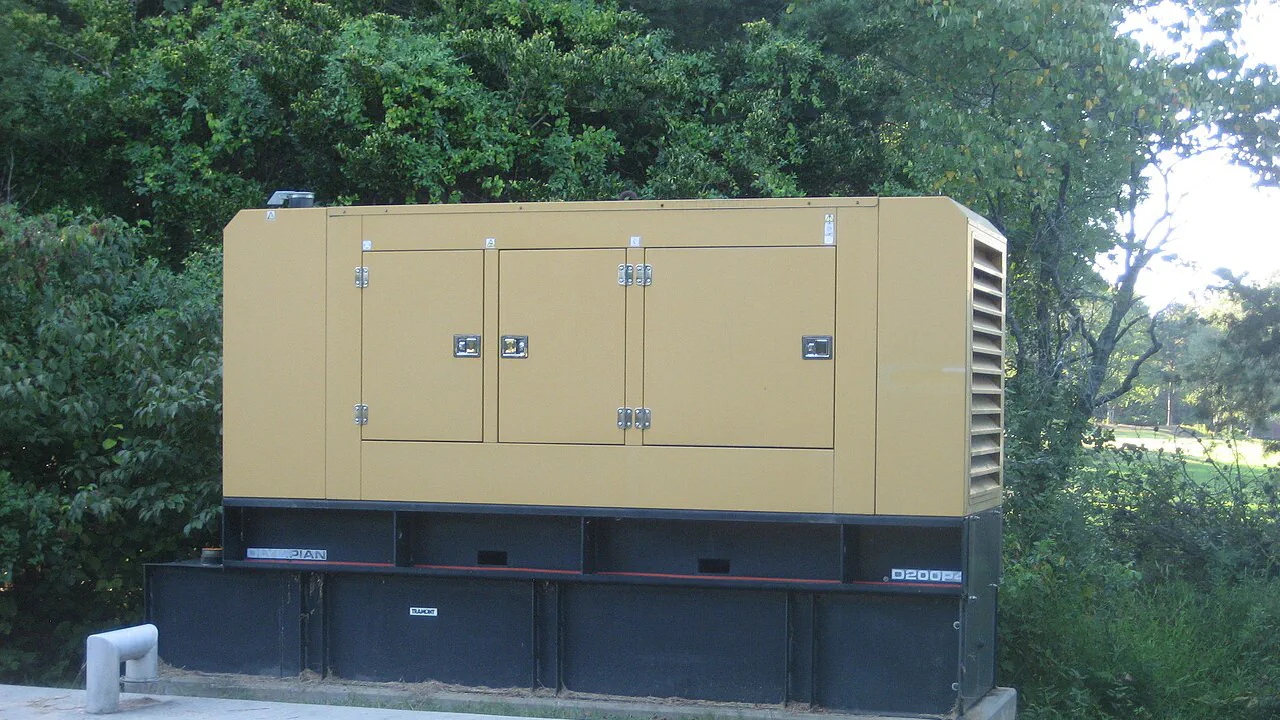
An enclosed diesel generator serving a sewer district near Atlanta. Its outdoor setting illustrates why enclosure, access and site conditions belong in the enquiry.
Photo: Gregsedits · CC BY-SA 3.0State the breaker ratings and functions
Ask the supplier to identify the proposed output breaker and state its electrical ratings, protective functions, and scope of supply. The enquiry should make clear whether the breaker is included with the generator, supplied separately, or provided through another project package.
Request information such as:
| Enquiry item | What to state or ask |
|---|---|
| Voltage and system | Confirm compatibility with the generator’s output and the project system. |
| Current rating | Identify the proposed rating and the basis for selecting it, including the connected conductors. |
| Interrupting or fault capability | Request the applicable rating and the fault-current information used to assess it. |
| Poles and switching | State the project requirement or ask the supplier to identify the proposed arrangement for review. |
| Trip functions | List the functions provided and identify which are adjustable, fixed, or handled elsewhere. |
| Disconnect and status | Clarify what the breaker disconnects and which status or alarm contacts are available. |
| Supply boundary | Identify who provides the breaker, protection device, settings, and associated interfaces. |
Do not treat “breaker included” as a complete protection specification. A breaker-free generator arrangement may still depend on specified overcurrent protection elsewhere. Rehlko’s discussion of UL 2200 says that overcurrent protection need not be provided with the generator set when its installation instructions specify the required protection; it also describes a particular APM603 controller as an equivalent means under two certified functions. These are qualified, manufacturer-specific statements, not a general conclusion that any controller or installation can replace a breaker. Rehlko, “Breaker-Free Generators with Alternator Overcurrent Protection”
Request curves, settings, and interfaces
For coordination review, request the supplier’s proposed settings and protection curves, along with the data needed to interpret them. Ask for the alternator thermal damage curve and the protection curve on a clearly identified basis. Cummins’ generator overcurrent protection material specifically recommends coordinating protection with the alternator thermal damage curve and submitting the damage and protection curves for verification. It also says the protection should allow continuous operation at the generator’s rated output and that the protection equipment provided should be third-party certified to verify performance. Cummins, “Generator Set Overcurrent Protection Options”
Ask the supplier to identify:
- Which device or controller performs each protection function.
- The proposed settings, setting ranges, and any fixed limits.
- The curve format, units, and operating conditions used.
- The generator fault-current information used in the coordination assessment.
- Whether the submitted protection data covers the intended operating arrangement, including parallel operation if applicable.
- The available trip, alarm, lockout, and breaker-position signals, with contact details and interface requirements.
- Any constraints, exclusions, or additional devices needed for the proposed arrangement.
Treat these as information requests, not instructions to select settings. The project team needs to evaluate them against the installation and downstream devices.
Record responsibilities and unresolved questions
Use the enquiry response to create a clear record of what is confirmed, what is assumed, and who must resolve remaining decisions. For each open item, name the responsible party and the information needed to close it.
A useful review record separates:
- Confirmed inputs: project data supplied and acknowledged by the supplier.
- Supplier proposal: breaker arrangement, functions, settings, curves, and interfaces offered.
- Assumptions: provisional system details or operating conditions used in the response.
- Open coordination questions: missing data, unresolved device relationships, or required project decisions.
- Design responsibility: who assesses settings and coordination, and who approves the final design.
If the supplier proposes a different protection arrangement from the one requested, ask for the difference and its consequences to be documented rather than silently accepting it as equivalent. Keep final protection decisions with the responsible project professionals; the enquiry is a way to obtain reviewable information, not proof of coordination or design approval.
Sources & scope
- Breaker-Free Generators with Alternator Overcurrent ...
- Generator Set Overcurrent Protection Options
General procurement guidance. Worked examples are illustrative; final selection requires the selected manufacturer's documentation and a project-specific engineering review.