Ask each supplier for the written warranty terms and service scope for the exact generator offered. Compare when coverage starts, how long it lasts, which components are covered, what conditions or exclusions apply, and who handles service, parts, travel, and escalation. Treat a warranty and a maintenance or service agreement as separate commitments unless the offer explicitly combines them.
Compare the warranty start, duration, and covered equipment
Request the warranty document that applies to the quoted model and duty, not only a brochure summary. Ask the supplier to state:
- The event that starts the warranty clock: shipment, delivery, installation, commissioning, or another event.
- The duration by calendar time and running hours, and whether coverage ends when the first limit is reached.
- Whether the terms differ for standby, prime, or continuous operation.
- Which equipment is covered: for example, the engine, alternator, controls, cooling package, enclosure, and complete generating set.
- Whether components have different coverage periods, and which document governs if summaries and full terms differ.
Warranty limits can use more than one measure. For example, a Rehlko B1400 product document states separate standby and prime/continuous periods measured from plant departure, commissioning, and running hours; it says the warranty expires when one of the stated conditions is met. It also directs buyers to the general terms and conditions for application and scope. These are model-specific terms, not a general warranty rule. (Rehlko B1400 product document)
Compare offers in a common format:
| Item to compare | What to request in writing |
|---|---|
| Start event | The event and evidence used to establish its date |
| Duration | Calendar limits, running-hour limits, and which limit ends coverage first |
| Duty category | The operating category the supplier has used for the offer |
| Covered equipment | Components included, excluded, or subject to separate terms |
| Warranty process | Who receives claims, assesses them, and authorizes work |
Do not compare headline duration alone. One Cummins QSK60 product sheet describes a two-year/5,000-hour warranty for the entire generating set and five-year/5,000-hour coverage for five critical engine components, including the above two years. The component coverage is therefore not five years in addition to the set warranty. This is a specific offer description; ask suppliers to identify equivalent boundaries and conditions rather than assuming that similar headline periods cover the same items. (Cummins QSK60 product sheet)
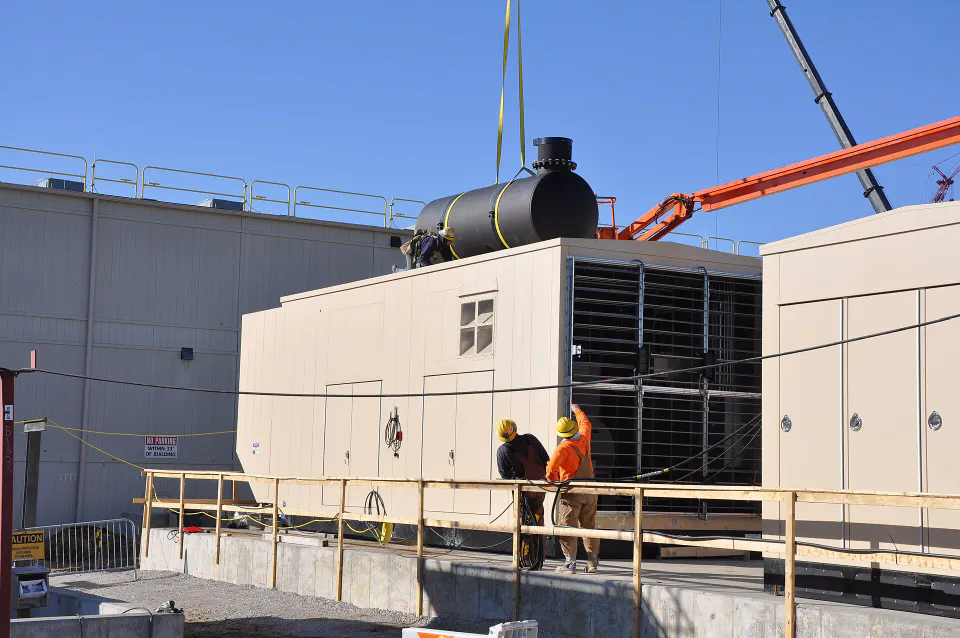
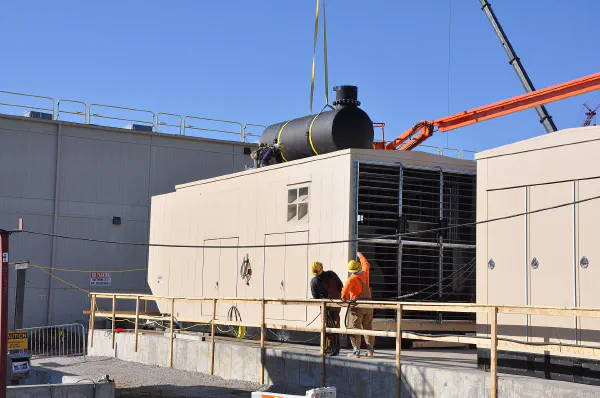
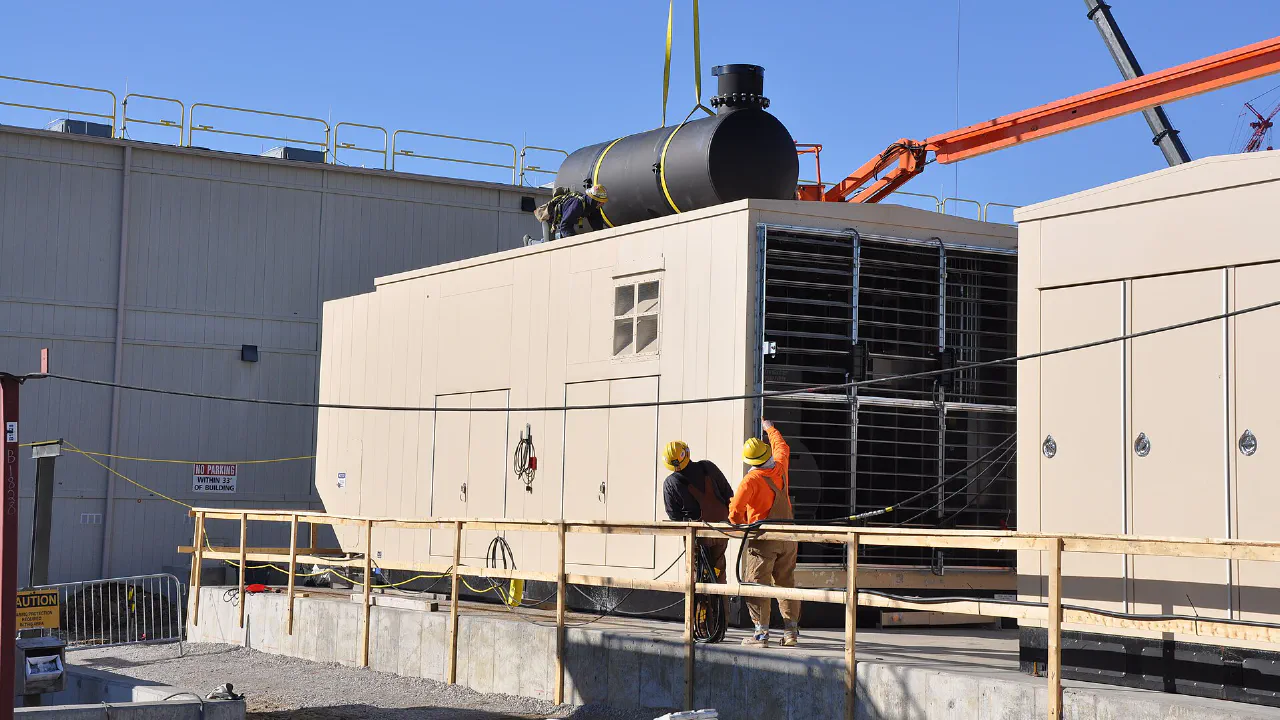
Installation of an exhaust muffler on a standby diesel generator at the Blue Grass pilot plant. Enclosure, exhaust and site access all need space.
Photo: PEO ACWA · CC BY 2.0Clarify exclusions, maintenance conditions, and buyer responsibilities
Ask suppliers to provide the complete exclusions and any maintenance or operating conditions that affect coverage. Clarify what records the buyer must keep, who may perform scheduled maintenance, and what happens if a required service is delayed or performed by a different provider. Ask whether wear items, fluids, adjustments, travel, labor, and freight are covered or billed separately; do not assume the answer from a warranty headline.
Also ask how the supplier defines proper application and operating conditions. Confirm that the quoted warranty applies to your stated duty and site conditions, and request any limits or assumptions that could affect eligibility. The Rehlko B1400 document, for example, refers buyers to general sales terms for details on warranty application and scope, showing why a summary alone may not answer these questions. (Rehlko B1400 product document)
A Cummins service manual excerpt describes warranty coverage for that manual’s product as failures directly resulting from defects in material or factory workmanship. This illustrates the need to ask what the supplier considers a covered failure and how it distinguishes that from other causes; it should not be treated as the wording for every Cummins product or every generator warranty. (Cummins service manual)
Separate service response from warranty coverage
A warranty does not, by itself, tell you how quickly help will arrive or what service is included. Ask the supplier to state:
- How to report a fault, including contacts and operating hours for support.
- Whether response commitments refer to acknowledgement, remote diagnosis, dispatch, or arrival on site.
- The service area and any conditions affecting availability.
- Whether labor, travel, parts, and freight are included, and who approves work.
- How urgent issues are escalated and who coordinates with the manufacturer or local service provider.
- Which planned maintenance tasks are included, how often they are scheduled, and what is excluded.
Request specific commitments where they matter to your operation. If an offer gives no response time or parts-availability commitment, record that as unspecified rather than treating general support language as a guarantee.
Keep planned maintenance distinct from warranty repair. Cummins describes its planned maintenance programs as including factory-recommended procedures, customized to the customer’s protocol; the excerpt does not establish that such a program is included with a generator purchase or warranty. (Cummins planned maintenance scope)
Record commissioning and unresolved issues
Ask who will document commissioning, what records will be supplied, and which event or document establishes the warranty start date. Request a dated handover record that identifies the generator and records the commissioning status, operating hours, and any open issues. Confirm how unresolved items will be assigned, tracked, and closed, and whether the supplier will confirm in writing that they do not change the warranty start or coverage.
Before accepting the offer, place the warranty terms, service inclusions, exclusions, response commitments, and open commissioning items side by side. Ask the supplier to resolve differences in writing. This gives procurement and technical teams a clear basis for comparing offers without assuming that similar warranty headlines mean equivalent coverage or service.
Sources & scope
- Industrial Diesel Generator Set – B1400 50 Hz
- PC3 3-QSK60 Standby 2250_2500kVA-Rev-3
- Service Manual
- Scope of Work for Planned Maintenance Programs | Cummins Inc.
General procurement guidance. Worked examples are illustrative; final selection requires the selected manufacturer's documentation and a project-specific engineering review.