Compare diesel-generator quotations on a like-for-like basis by first fixing the required rating and operating conditions, then listing what each offer includes, excludes, assumes and leaves unanswered. Do not compare headline prices until you have identified scope differences; ask suppliers to clarify gaps and revise their offers against the same written requirement.
What information should you align before comparing prices?
Start with one common requirement sheet. Record the intended application, required power rating and rating basis, frequency, phase, voltage, and any site or operating conditions that affect the requested package. Separate confirmed requirements from assumptions that still need checking.
Pay particular attention to the rating basis. A model may have different prime, standby or other stated ratings: for example, Cummins lists separate prime, standby and data-center continuous ratings for its C1400D5 model. Compare the rating that matches your requirement, not just a similar kVA figure on the quote. Cummins C1400D5 specifications
Ask each supplier to identify the quoted model and state the rating, frequency and configuration it is offering. Manufacturer product listings may distinguish models by details such as engine, alternator frame and controller, so a matching headline capacity alone does not establish that two offers have the same configuration. Cummins diesel generator listings
If any required input is undecided, mark it as open rather than silently treating different supplier assumptions as equivalent. For related preparation, see the RFQ checklist and guides to generator voltage, frequency and phase and prime versus standby ratings.
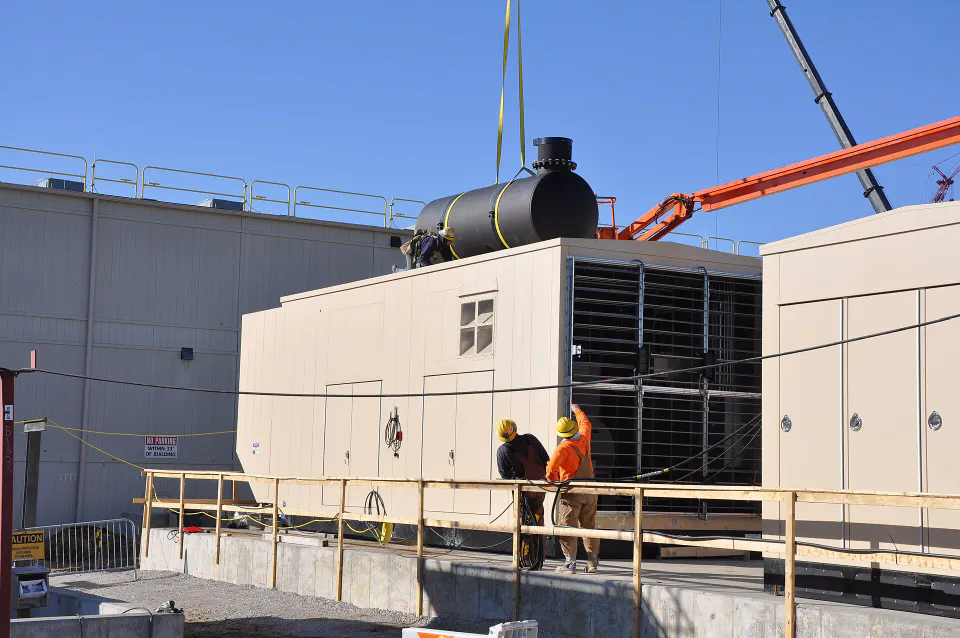
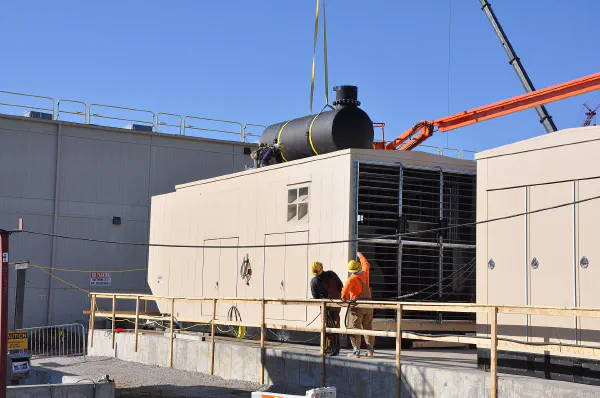
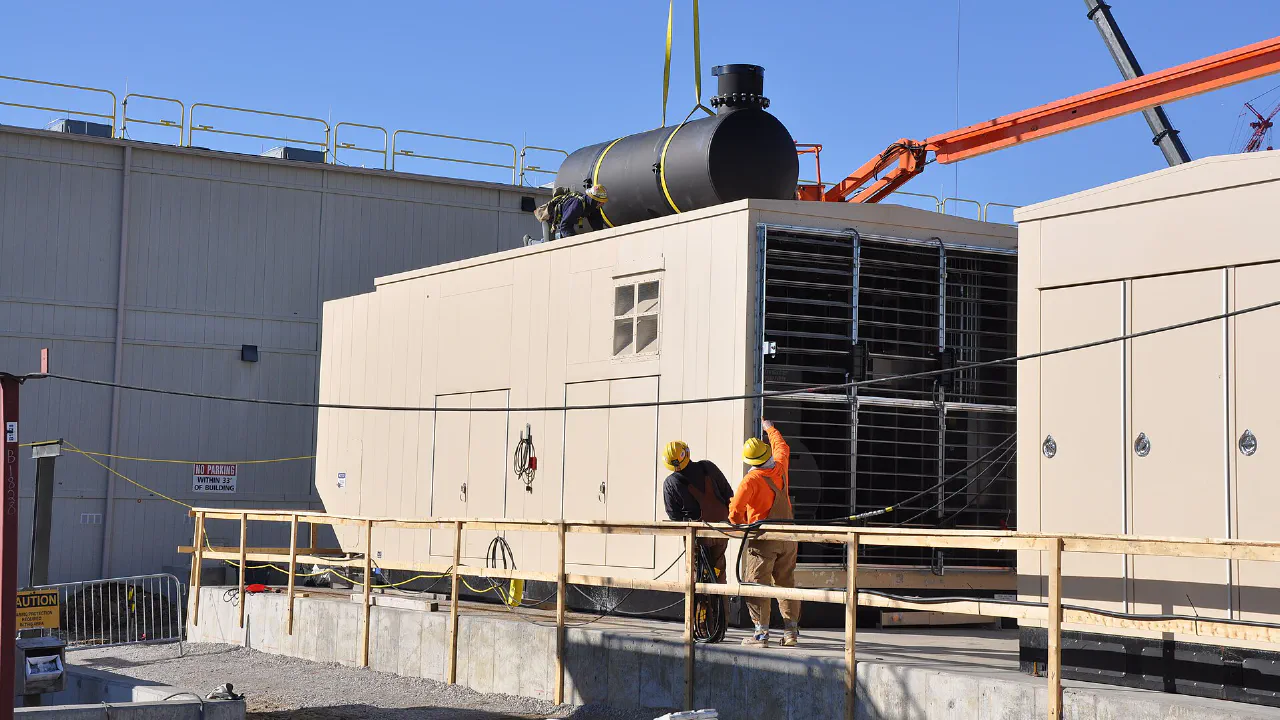
Installation of an exhaust muffler on a standby diesel generator at the Blue Grass pilot plant. Enclosure, exhaust and site access all need space.
Photo: PEO ACWA · CC BY 2.0Which equipment and services are included?
Break each quotation into equipment, accessories, services and commercial terms. Use the same categories for every supplier, even if their quote formats differ. For each item, record whether it is included, excluded, optional, or unclear—and note the offered specification where one is given.
| Category | What to compare or ask |
|---|---|
| Generator set | Exact model, rating basis, frequency, phase and voltage |
| Main components | Engine, alternator and controller details, where specified |
| Package configuration | Enclosure or unhoused configuration, and any other stated package features |
| Supplied accessories | List each offered accessory and its stated specification; ask whether required items are included |
| Services | Delivery, installation, commissioning, training or maintenance, if offered |
| Commercial terms | Currency, delivery basis, validity period, payment terms and warranty terms as written |
Treat this as a comparison checklist, not a universal list of equipment that every generator package must include. Ask suppliers to identify any item that is not part of their offer rather than assuming it comes with the set. Manufacturer listings, for example, present generator models alongside specific component and configuration information; the comparison should capture the details actually offered for your project, not infer them from a model family. Cummins diesel generator listings
For services, ask for a defined description and deliverable. “Maintenance included” is not enough to compare plans unless the supplier states what work, period and responsibilities are covered. Cummins describes its planned maintenance programs as customized to a customer’s protocol, illustrating why a service label alone does not establish matching scope. Cummins planned maintenance program scope
What installation, commissioning or other exclusions should you clarify?
Ask where the supplier’s responsibility begins and ends. Depending on the offer, clarify whether delivery, unloading, positioning, installation, commissioning, operator familiarization and follow-up service are included, excluded or available at additional cost. These are questions to put to suppliers—not assumptions that any particular task is part of a standard package.
Also ask the supplier to state what it expects the buyer or another contractor to provide. Record site preparation, connections, permits, fuel arrangements or other project interfaces as open items unless the quotation clearly assigns responsibility. Have relevant site and technical requirements checked by the responsible project professionals; a commercial comparison does not approve an installation design.
Request the cost or pricing treatment for excluded work where it is available. If a supplier cannot price an item yet, record that limitation and the information needed to resolve it. Keep optional items separate from the quoted base scope so that an apparently lower price is not compared against a more complete offer.
How should you record differences and unanswered questions?
Use a comparison sheet with one row per requirement or scope item and one column per supplier. Add a status—included, excluded, optional, unclear or not applicable—and cite the relevant quotation page or section. Keep the supplier’s wording where it affects interpretation.
A simple record could look like this:
| Item | Supplier A | Supplier B | Question or action |
|---|---|---|---|
| Rating basis | Quoted basis stated | Not stated | Confirm the basis and applicable rating |
| Enclosure | Included as described | Optional | Confirm configuration and price effect |
| Commissioning | Excluded | Scope unclear | Define responsibility and requested service |
| Delivery and unloading | Delivery stated; unloading unclear | Not stated | Confirm delivery boundary and unloading responsibility |
| Maintenance | Optional plan described | Not stated | Request scope, period and price if needed |
Do not fill gaps by guessing. Send each supplier the same clarification questions, then request a revised quotation or written confirmation that aligns with the common requirement sheet. Keep an assumptions-and-open-questions list beside the price comparison. Once the scope is aligned—or remaining differences are clearly priced and accepted—you can make a fairer commercial comparison without mistaking different packages for equivalent offers.
Sources & scope
- Generator models | C1400D5 | Cummins Inc.
- Diesel Generators | Cummins Inc.
- Scope of Work for Planned Maintenance Programs | Cummins Inc.
General procurement guidance. Worked examples are illustrative; final selection requires the selected manufacturer's documentation and a project-specific engineering review.